This month I saw Gianmarco Soresi tell a funny set of jokes about being born a child of divorce. His first word was “Ma-ma. . . told me to tell you.” He has four half-siblings. . . which means he has two. And when asked why he’s still talking about his parents’ divorce at the age of 36, he explains that if you were living on a faulty foundation, “would you feel any safer on the 36th FLOOR?!”
There are three interesting things happening underneath these jokes.
Spire Light is a reader-supported publication. To receive new posts and support my work, consider becoming a free or paid subscriber.
In just a few seconds, we have built a schema (a framework, a mental map, etc.) about who this comedian is. Everything we know and assume about being a child of divorce gives us a framework for him moving forward. Future jokes might call back to that and heighten the humor.
It presents an acceptance with a present and ongoing reality. One doesn’t simply stop being a child of divorce just because you’ve aged. It is a continuous part of his existence.
The metaphor succinctly captures the very-adult-feeling of leveling up to more complexity, wider unknowns, and fresh fears. yay. . . So in that vein. . .
I knew about students cheating their work and how to create AI policies.
I knew about lawsuits when AI was trained on author’s books illegally.
I knew about data centers causing a water crisis.
I knew about medical scans getting more effective and advanced.
I knew about sycophantic language models (chatbots) causing bleak tragedies.
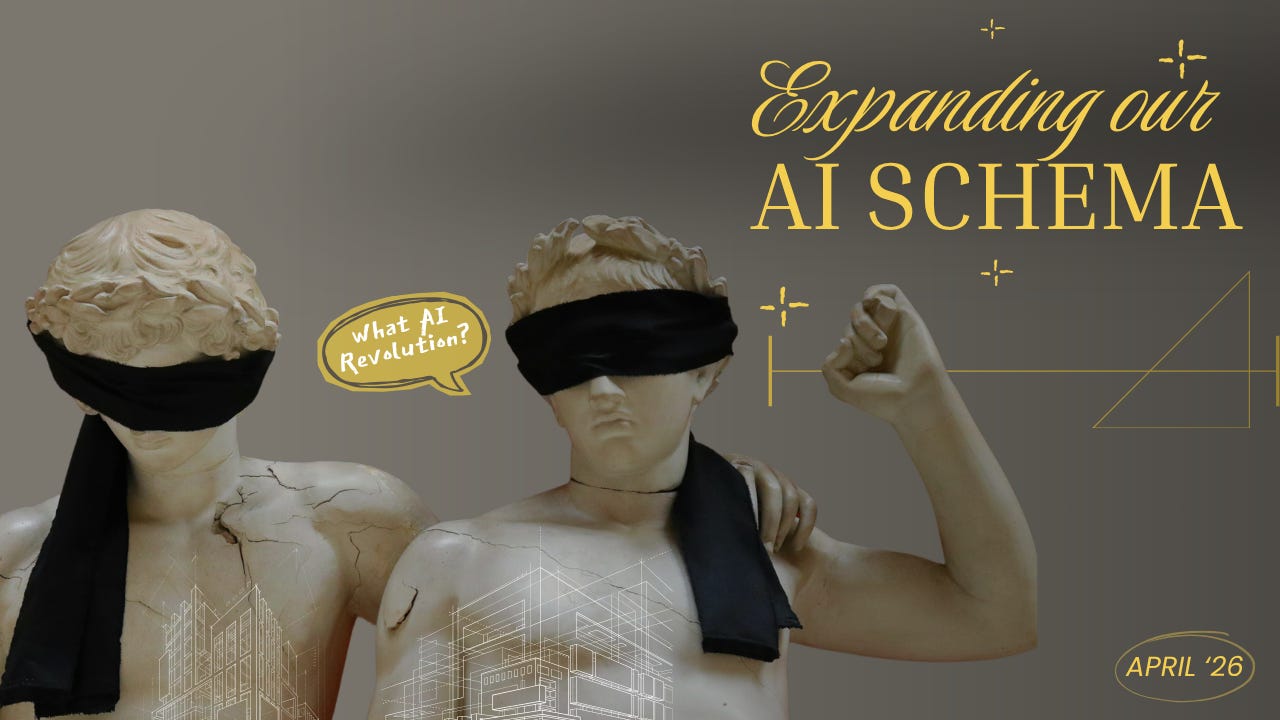
But all of these items floated like loose papers in a 6th grader’s disorganized backpack. I didn’t know how they fit together or why things are so suddenly the digital wild west! The only reaction that made sense after seeing the imbalanced number of bad things was to be “anti-AI” and try to boycott and ignore it.
Acceptance with a present and ongoing reality.
But for better or very worse, the AI Revolution is here. One does not simply stop the world from technologically advancing.
As Daniel Kwan put it, “Everything has really become this binary that leads to…a lot of gridlock. And what happens when you have gridlock, nothing gets done except for the things that the people in power want to get done.”
Leveling up to more complexity, wider unknowns, and fresh fears.
The film does an excellent job showcasing the emotional weight of wading through these interviews. Daniel Roher uses a very ADHD sketchbook to illustrate his journey with gathering more information and more anxiety all at once.
Many parts of life require us to sit in that tension—where the messiness of the conversations must be tolerated.
As one film reviewer put it, “How we use A.I. will be one of the most important conversations in the history of mankind…”
But in the end, the very-human frame story of Daniel Roher’s impending parenthood grounds the film and keeps it from being sci-fi nightmare fuel. Don’t worry.
Someone Shared it / Writing Update
Speaking of framing, it’s been the theme of my drafting this month. I’ve been trying to not let my EDITING brain overtake my CLOWN brain, as Scott Dikkers said. (That article from a few years ago is a really good read. It basically points out that being a professional writer means finding ways to separate and balance creativity and critique. As the editor of The Onion, he was constantly suggesting tweaks and rewrites, and had let his free, creative side atrophy. . . Teaching for so many years has put me in a similar spot.)
But one of the most difficult parts of drafting is realizing—mid-writing session— how much the framing of a scene can shift its efficacy. It’s hard to quiet those editor-like ideas.
How does one character being worried change the tension?
How does it feel if she doesn’t know [that particular piece of information] and is naive and happy?
What happens if this scene is at a cat funeral instead? [yes, a cat funeral.]
The conclusion is that I give myself a few minutes to contemplate or try out these ideas when they have a strong pull— while still prioritizing my free clown brain. First and foremost, the draft must be finished to truly know the answers to those editing-brain questions.
Every month, I’ve annotated a book to giveaway in the secret chat! Last month, poetry stickers went out to everyone who claimed them. Hop in there to see what’s up for grabs this month!
Someone Sang It.
Just a classic that’s been fitting some character inspiration for me this year:
Someone Said it.
Andif you, like me, are doing the continuous work at reframing difficult situations, here’s a quote to take on your way out.
“You may encounter many defeats, but you must not be defeated. In fact, the encountering may be the very experience which creates the vitality and the power to endure.
— MAYA ANGELOU
Spire Light is a reader-supported publication. To receive new posts and support my work, consider becoming a free or paid subscriber.